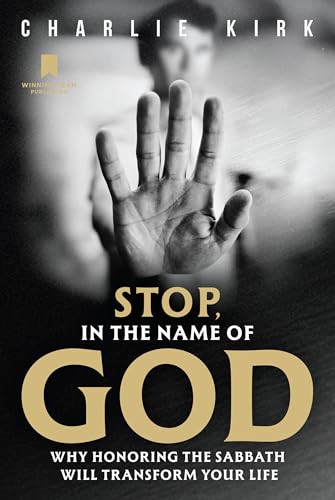
Stop, in the Name of God: Why Honoring the Sabbath Will Transform Your Life will help you discover how observing the Sabbath isn't a rejection of modern life but a rebellion against busyness and a pathway to genuine connection, peace, and presence. Through Stop in the Name of God, bestselling author Charlie Kirk guides you on how to unplug, recharge, and reconnect with God, family, and yourself in a way that nurtures your soul. In a world dominated by screens and constant noise, Stop in the Name of God presents the Sabbath as a radical act of resistance. Packed with practical insights and spiritual wisdom, Charlie Kirk demonstrates how honoring the Sabbath restores balance, reduces anxiety, and nourishes your soul. It's not just a day of rest-it's a lifeline to reclaiming what truly matters.
Charlie Kirk was the Founder and President of Turning Point USA, a national student movement dedicated to identifying, organizing, and empowering young people to promote the principles of free markets and limited government.
He stood unshaken, a voice in the storm A man of conviction, a heart reborn He spoke the truth when the cost was high He lived for Jesus, unafraid to die We are Charlie Kirk, we carry the flame We'll fight for the Gospel, we'll honor his name We are Charlie Kirk, his courage, our own Together unbroken, we'll make Heaven known A husband, a father, his family held near A home built on scripture, on faith, without fear The world tried to silence but his voice remains In us, it echoes, in Christ, it sustains We are Charlie Kirk, we carry the flame We'll fight for the Gospel, we'll honor his name We are Charlie Kirk, his courage, our own Together unbroken, we'll make Heaven known The battle is raging, the darkness will fall We rise with his spirit, we answer the call The truth is eternal, the cross is our guide With God as our captain, we march side by side We are Charlie Kirk, we carry the flame We'll fight for the Gospel, we'll honor his name We are Charlie Kirk, his courage, our own Together unbroken, we'll make Heaven known We are Charlie Kirk Forever alive We are Charlie Kirk With God, we will rise
This entire review has been hidden because of spoilers.
I have kept the Sabbath for years... but this book brings me to a new level of intimacy with our Creator. Thank you, God for inspiring Charlie to write this book in Your timing and with Your great grace. May it touch the hearts of those who are yearning to come closer to Your life and Your light.
I began personally observing the Sabbath rest several weeks before Charlie was assassinated. In my desire to learn more about what he stood for, I looked into any books he had published, and coincidentally (I don't believe in coincidences) this book stood out to me as a guide to something I was seeking God's wisdom and leading on. It was a great wake up call and a great encouragement. Sabbath rest is one of the Big Ten, a clear command from God to honor the sabbath day every week and keep it holy, which means set apart from the rest of the week. In the hustle culture of social media and the American world around us, rest is something to mock, something to be ashamed of. Charlie challenges that perspectives and helps shine a light on the freedom we gain when we are in line with God's commandments, and how richly we can live our lives when we seek God's design in our lives. I would like to read this book at least once a year to continue to embrace slowing down and practically holding myself accountable. Highly recommend this read to any Christian who is curious about a modern explanation on what could be seen as an outdated tradition. We need it now more than ever.
One of this year’s hottest books comes trailing clouds of sorrow.
On Sept. 10, conservative activist Charlie Kirk was shot dead while speaking at Utah Valley University. This week, his final book, “Stop, in the Name of God,” was released by Winning Team, the publishing house co-founded by Donald Trump Jr.
Despite a reported first printing of 200,000, the book was almost immediately out of stock on Amazon, where it was the No. 1 bestseller for several days.
Given the politically aggressive nature of Kirk’s work, even alongside his frequent invocations of Christian faith, “Stop” — subtitled “Why Honoring the Sabbath Will Transform Your Life” — often feels composed in a different register. “The following pages,” he says at one point, “are not written from a mountaintop of certainty, but from a well-worn path of seeking.”
Indeed, much of this posthumously published book is committed to theological arguments, devotional reflections and practical advice on reclaiming the Sabbath to restore spiritual balance in a culture overstimulated by technology and consumerism. Throughout, he expresses heartfelt admiration for Hebrew scripture and Jewish tradition. Christians eager to consider whether Jesus Christ’s new covenant means they’re bound to Sabbath observance will find here chapter and verse.
Although I have no sympathy for the political agenda Kirk espoused, as an overworked, chronically distracted person of faith who rarely enjoys a holy day of rest, I’m inspired by his book’s admonition to take the Fourth Commandment seriously.
But “Stop” is also a strange, uneven volume that sometimes gets lost in the wilderness.
In chapter 1, we read: “Growing up, atheism was fashionable,” which makes me pine for a photo of toddler atheism in chic short pants. And the book is padded with numbing repetition, including verbatim redundancies that spark a disorienting sense of deja vu. On p. 70, for instance, Kirk writes, “Historian Daniel Boorstin observed, ‘In no other civilization has a day of rest been so deeply institutionalized,” and on the next page he tells us, “Historian Daniel Boorstin observed that in no other civilization had a day of rest been so deeply institutionalized.”
Better copyediting could have corrected those flaws, but Kirk’s prose is more deeply marred by a rhetorical strategy that poses as clarifying but soon feels like a tic. Again and again, he claims that something is not this, it’s that:
• “The Sabbath is not primarily a legal command — it is a cosmic declaration.” • “Genesis 1:1 is not just an origin story — it is the first step in a divine arc.” • “These are not just buildings; they are theological statements.”
Leaning so heavily on this binary frame suggests the central weakness of Kirk’s approach: his substitution of stylistic flourish for nuanced argument. That habit becomes particularly troublesome when he attempts to prove the divine origin of the Sabbath or to disprove the possibility of morality without God.
In an effort to sound supremely confident — “Millions follow me for clarity on the great and most pressing issues of our time” — Kirk sounds merely out of his depth. His grasp of world history and religious history is spotty; his philosophical analysis displays the rigor of a late-night bull session after the pizza has grown cold. False choices, straw man arguments, cosmic leaps — it’s a Macy’s parade of inflated fallacies. When he speaks from the heart about the blessings of setting aside a day every week, he can be genuinely moving; when he tries to make a case for Intelligent Design, he should be moving on.
In a book about the importance of periodically withdrawing from the cycle of getting and spending, it’s no surprise to find....
“How can it be that in an age of abundance, our youth feel more worthless than ever? It is because material progress cannot fill a spiritual void. We have given them everything except the one thing they were made for: meaning. When a culture denies its Creator, it also denies its children the ability to know who they are, why they exist, and what they are worth. The result is not liberation—it is devastation. We have everything to live with but nothing to live for.”
“The Sabbath is not a cultural artifact. It is a covenantal gift. It was not man’s idea, but God’s. It is not rooted in utility, but in revelation. And as long as there are people weary of the world’s pace, there will be a remnant who hear its call. The real question, then, is not whether the Sabbath will survive. It will. The question is whether we will remember. Whether we will reclaim what was given—not as a rule to restrict us, but as a mercy to restore us. Whether we will trust that our worth is not measured in output, but in being known by God. Whether we will dare to stop—not as an act of laziness, but as an act of rebellion against the cult of ceaseless striving. To keep the Sabbath in an age of frenzy is to declare this with your body and your time: I am not my own. I am not a machine. I will rest, because God rested. I will remember, because He remembered me. Let the world race on. But as for me and my house—we will stop.”
An absolutely beautiful and increasingly important book.
This whole book is a perfect read if you are into delving into an example of a well executed psyop. Just be prepared. I do not recommend this book if you are a Christian; the title alone should cause you to be wary. Not just because Christians do not celebrate or honor the Sabbath, we honor the 7th day (Sunday), but we do not speak in the name of God. You cannot be two faiths; only one. This whole book is garbage and an attempt to use Charlie's good name as a tool to push other peoples' agenda.
Also, to Erika Kirk. Why did you think this title was going to be okay? Christians do not take the Lord's name in vain, nor do we speak in God's name. Charlie never proclaimed to be a prophet so why, Erika, did you name it in this way? It is very un-Christian.
Charlie is a smart Godly man. At times his intellect was way over my head but for the most part he really got me thinking that I need to honor a 24 hour Sabbath and unplug. Technology is good but also gets in the way of so many interpersonal situations. I’m gonna give it a try.
Charlie Kirk complains (as he was one to do) that church attendance and identification with a church has gone down. He proposes a return to the Sabbath with the exhortation of a self-help book promising any number of positive changes including weight loss. (118) He attributes this decline to the same list of causes that everyone else complaining about religious practice has ever noted: Modernity! “Our modern gods are autonomy, affirmation, and endless choice.” (P.3) I actually believe there is something to this but not in the way Charlie wrote. For almost the past half century the mainstream political position of both major political parties and the entire Western world has been neoliberalism. In Margaret Thatcher’s words:
“there are individual men and women and there are families and no government can do anything except through people and people look to themselves first.”
Contrary to Charlie’s assertions over the years of “Woke,” or “Marxism,” or “socialism” the neoliberalism espoused by Margaret Thatcher is all there is. One of the enduring ironies of today’s far-right is that they got nearly everything they wanted… except! in largely dismantling the state to its most minimal function of protecting private property they expected that organized churches would step into the vacuum and take over those social services vacated by governments. Instead what happened is that religion has been commodified as well. “Autonomy, affirmation, and endless choice…” the Market couldn’t guarantee eternal life at the Lord’s table but it can give you everything you’d never want in ‘Cool Ranch flavor.’ Joel Osteen and Kenneth Copeland were just savvy and fused the two. It never gets old seeing the far-right flabbergasted that The Market doesn’t mark the Sabbath and keep it holy. I wouldn’t necessarily consider neoliberalism the sole reason for the decline of church attendance and I do have another theory. On April 9th, 2022 a man named Jonathan Neo of Singapore posted an instagram video of himself hijacking a plane. No, he didn’t have a bomb-that would have only been too merciful. Instead, he whipped out a guitar and began singing Christian hymns while his hostages-er-audience looked away or plugged their ears. The same group had previously spent some time singing to Ukrainian refugees (another moment he was sure to record and post). When I saw this for the first time I got to thinking that being in the United States right now is a little like being trapped at 30,000 feet with that proselytizing douchebag and his guitar. Every year beginning around Thanksgiving the Right Wing Outrage Machine sounds out the battle lines in an ongoing “War on Christmas.” The bugle is then taken up in statehouses, by newspapers, and television networks. Every year it is said, defeat is imminent. “Merry Christmas,” has been banned. Socialists such as myself are on rooftops with Santa Claus in our rifle scopes. Every time Disney releases a new movie this same Outrage Machine will scour the movie frame by frame for something with which to find offence to their faith. School bus backup lights actually have Luciferian symbols in them. Jews are putting the blood of Christian children into fast food. Earthquakes are God’s displeasure after Charlie’s assassination. Hurricanes are because of gay marriage. John Cena was performing a satanic ritual. The Olympic Games are mocking Christianity. And so it goes. This might all be overlooked as merely obnoxious were it not for the fact that these same people are writing, enforcing, and interpreting laws in their favor. The reason I mention all of these examples is that since Christianity has not gone anywhere and is instead more prominent and influential in our public life than it has likely ever been (there is now a White House Faith Office a successor to a Bush II era creation) I attribute a decline in church identification and religion to most Americans being sick of the never-ending Culture War bullshit espoused by self-proclaimed Christians the late-Charlie Kirk included. No amount of Bible study or Sabbath honoring by everyone else is going to erase the fact that the Grindr app goes down when evangelicals meet en masse to oppose the right to women’s suffrage. I am not an opponent of Christianity by any means-I am a Lutheran and a member of a church but, a central part of these mainline Protestant churches that I like and also believe should be more prevalent is ‘Shutting up about it.’ I don’t believe that bragging out loud about honoring the Sabbath glorifies God when these days prayer is the last refuge of the scoundrel.
I've been increasingly interested in Sabbath recently, so I was excited to find a recent book on it written from the Christian perspective.
This book is written for both Christians and non-Christians, as Kirk spends the first few chapters explaining his Christian beliefs and justifying the choice to follow Scripture. If you've been a Christian for a while, you might skim/scan some of these chapters, as a lot of it is info you might already know (I skimmed a few chapters).
What I appreciated most about this book is it isn't just Kirk's opinion on Sabbath. He provided statistics and information on the following:
- Rest from a secular perspective - Historical/biblical Jewish Sabbath - Support for Christians honoring Sabbath - Support for Christians not honoring Sabbath - Lots of research - Lots of Bible references - Personal reflection and anecdotes
For any Christians contemplating Sabbath and the case for/against it, I highly recommend this book.
This one hurt. Charlie wrote the way he spoke. You can hear his unmistakable cadence, his crisp delivery and perfect word choices in every sentence. And his message in this last written work is the same one he delivered in person. We are made by God for His glory.
The theme of this book is simple: the sabbath was created for man, not man for the sabbath. It is a rhythm designed to bring you closer to God; to remind you of the spiritual realm: to keep you from falling into the idolatry of endless materialism; to remind you that you are no longer a slave, but free in mind and spirit.
I hope you will buy this book so that it cannot be ignored by bestseller lists. But I also hope you will read it with a sense of grief and sadness, righteous anger and unshakable resolve. Charlie’s assassination has not yet been digested, its impact still to be revealed.
It’s hard to read this book and not hear a lone fiddle in the mist of your mind. “Mine eyes have seen the glory of the coming of the Lord…”. Buy it at retail, in hardback. Send a message. And then read it with an open heart. You’ll be glad you did.
This book by American Hero Charlie Kirk is an amazing study on rest and the effects on our well being. Taking a multifaceted approach, sourcing from religion, science, and philosophy, Kirk shows the physical and mental benefits of religion on humanity. Considering the tumultuous times, this cure is exactly what Americans need right now.
If I could give this book more than 5 stars I would. This book was truly life-changing for me. I make an effort to put my phone away and live in the moment a good amount, but I know I can and should be doing more to disconnect and honor God by spending more time with Him and the beautiful world He has created and with others. I will be making a stronger effort going forward in life and can’t wait to see and feel the peace that brings. Read this book. You will not regret it.
"What is a legacy? It's planting seeds in a garden you never get to see."~L-MM
So much wisdom. To hold this book in your hand was like chatting with a friend.
“Those of us who knew him best, talk about him often Sometimes it makes me sad though, him being gone. I have to remind myself that some birds just aren’t meant to stay. Their feathers are just too bright. And when they fly away, part of you knows it was a sin. That the place you live is that much more drab and empty now that he's gone. I guess I just miss my friend.” Shabbat Shalom Charlie.
While I have read a little on the subject of “sabbathing” in other books, this is the first book that was written entirely on the subject. However, more than a third of the book isn’t directly about the sabbath, but laying the foundation for why a person would even observe it in the first place (spoiler: it’s about what you worship). The first five chapters are very heavy on apologetics and history. While most are things I’ve read in other books, it would be very helpful for anyone who hasn’t considered the impact of what you believe about Genesis 1:1, and it was still an excellent review for me. I do have a minor complaint: several times in these chapters I noticed paragraphs repeated almost verbatim. After the third time this happened I couldn’t decide if it was a bug or a feature, because I did actually remember those paragraphs better, which may have been the point all along? Also, the alliteration in the book was ever so slightly over done in my opinion.
The next few chapters explore the benefits that sabbath keeping communities experience (better health, better sleep, etc). I noticed there is no dedicated notes section in the back of the book where Kirk directly references these studies. However, he does give enough information in the actual chapter so that a person could google the studies to find and double check the information. I also think it’s short sighted to credit sabbath keeping alone with the improved health and happiness experienced in sabbath keeping communities. Most Jews and Seventh Day Adventists are also very strict with their diets, which can play a large role in health and happiness. This section also felt rather legalistic, tho once I finished the book I realized Kirk wasn’t necessarily advocating for sabbathing exactly how these groups do it, but was rather explaining how the groups do it.
Finally, I made it to chapter 9 and beyond, where I found the meat of what I was looking for: the exploration of whether Christians are bound to the sabbath, arguments for and against sabbath keeping, thoughts from early church fathers, and finally a blueprint to begin sabbathing. Obviously Kirk is pro-sabbath, tho not in a legalistic way like the Jews and Seventh Day Adventists keep it. Even the chapter with arguments against sabbath keeping were very pro-rest (In the words of Martin Luther, who is quoted in the book: “It is not necessary to observe the sabbath or Sunday because of Moses’ commandment. Nature also shows and teaches that one must now and then rest a day.”)
This is the first book that I’ve read in which sabbath keeping is presented strongly as an exercise of resistance against the worship of today’s cultural gods. One of my favorite quotes from the book is, “Your sabbath is not just about you. It is not a private act of self-care, but a public declaration of allegiance to a different kingdom. In a culture drunk on exhaustion, your refusal to live life at a frantic pace is a form of protest. Your rest says, God is my provider. I do not have to earn my worth. I am not owned by the clock or controlled by the crowd….That’s the legacy Sabbath helps build--not just one of rest, but of witness. In a world that never stops, be the person who knows how to stop well. Not because you’re lazy, but because you trust the Lord of time more than the tyranny of hustle. That’s Sabbath. That’s freedom. That’s worship.”
Other quotes I liked (which are all from chapter 9 and beyond):
“The Sabbath is not first and foremost about what we can’t do--it is about what we get to do. We get to stop. We get to rest. We get to worship without distraction. And in doing so, we remember that God is God--and we are not.”
“Don’t make excuses. Make adjustments. Don’t give up. Get creative. Rest is not about perfection--it’s about intention. The goal isn’t to follow a legalistic rule, but to cultivate a sacred rhythm of freedom and trust. Sabbath is not a burden. It’s a gift. And like all good gifts, it requires humility to receive and courage to protect.”
“Rest requires courage. It means confronting our fear that the world will fall apart if we stop working. It means choosing trust over control. And it means recognizing that the things that matter most--our health, our relationships, our spiritual life--cannot thrive on leftovers….Rest doesn’t wait for life to get easier--it shows up as resistance within the chaos.”
“The Sabbath was never meant to cancel your joy--it’s meant to sanctify it. God didn’t tell you to become somber and bored for twenty-four hours. He’s not anti-laughter, anti-celebration, or anti-fun. He simply wants to reorient our joy to what lasts. The Sabbath is the space where delight is deepened, not dulled.”
The assassination of Charlie Kirk was a disgusting and shocking moment for many last year, myself included. Here was a guy the same age as me, who I’d followed online for a long time, and had similar convictions about the world. His arguments played a big part in bringing me back into contemporary conservative politics and also gave encouragement to my faith—then one day he was gone. Why? What happened? Can we not have civil debate anymore, without trying to kill each other across political and cultural divides? I’m still trying to make sense of it. But one thing’s for sure, it impacted me and gave me increased resolve for attending Mass every Sunday and doubling down on the way I want to live my life: traditionally, conservatively, putting God and my family and my community first, over the manifold distractions of the world.
In that spirit I picked up this latest, and sadly, final, book by Kirk, the topic of which is keeping a weekly Sabbath. Kirk looks at the fourth commandment of the decalogue in the Old Testament, Exodus 20:8-11:
Remember the sabbath day, and keep it holy. Six days you shall labor and do all your work. But the seventh day is a sabbath to the Lord your God; you shall not do any work—you, your son or your daughter, your male or female slave, your livestock, or the alien resident in your towns. For in six days the Lord made heaven and earth, the sea, and all that is in them, but rested the seventh day; therefore the Lord blessed the sabbath day and consecrated it.
While accepting that Christ in the New Testament started a new covenant, with the early church fathers replacing the Jewish Saturday Sabbath with the weekly worship rhythm of Sunday as the Lord’s Day, being the day that God made the world and the day of Christ’s resurrection, Kirk nevertheless encourages us to embrace the idea of switching off from the demands of the world, from work, from emails and Slack and Microsoft Teams, and also from our smartphones and social media, to have a proper day of rest: a Sabbath. He says, ‘In a world obsessed with doing everything, and obsessed with doing nothing, the Sabbath is God’s ancient, enduring answer’. He explains this understanding helped him take a rest despite his busy life leading two major political campaign organisations in Turning Point USA and Turning Point Action, and raising his young family, and that he would invite friends and relatives for lunch or dinner where they would put their smartphones in a basket by the door and engage in genuine and meaningful interactions without screens. He claims that this made a wonderful difference in his life, with him reporting better health, relationships, and spiritual fulfillment. Well, it all sounds good to me, and if someone as busy as Kirk could do it, I want to try it too.
This book goes deep into the biblical and theological ideas behind the Sabbath, looking at it from the classic Jewish perspective and also from the viewpoints of different Christians of various denominations, but Kirk sometimes loses focus and in the middle section he departs from looking at the Sabbath and how Christians can take a kind of Sabbath today, instead addressing the current political and cultural climate. He rails against the screen-addicted modern generations, who report higher levels of stress and anxiety than previous generations who came before the internet and smartphones. He also addresses the idea that instead of God we are setting up false idols again, like ancient pagans, in the form of self-glorification and vanity on social media, chasing career success and wealth, and losing ourselves in pleasure of various kinds. While I do generally agree and enjoy reading his riffs on the ills of the present day in the West, I think the topic of the book got away from him a little, perhaps deliberately so that he could pad it out. Still, if you do consider yourself to be aligned with Kirk, it isn’t necessarily a bad thing; it just becomes tangential and a repetition of ideas he often voiced on his radio show and YouTube videos from campus debates.
Overall this is an important read for Christians and I think hearing Kirk’s ideas on this topic that was so personal to him is a great way to commemorate his life. It’s incredibly sad to think this bold, moral voice will never speak again but the 32 years he did live were lived to the full and the young people he inspired will continue to carry out his Turning Point mission of fixing the broken, brainwashed youth. That at least is comforting.
Excellent. Just excellent. Stop in the Name of God is both a work of apologetics and a thoughtful treatise on the Sabbath. While I find freedom in understanding the Old Testament Sabbath not as a strictly mandated 24-hour observance but as a principle meant for the blessing of rest, this book impressed upon me the weight and wisdom of intentional rest in a deeper way.
Kirk also addresses the false gods of our culture and offers a compelling defense for this modern world of the reality of a Creator God, effectively setting the stage for the worship of God alone through the holy practice of Sabbath rest. I had never read anything by Kirk prior to this book and wasn’t quite sure what to expect—other than a desire to encounter his final words. I ended up enjoying it far more than I anticipated.
Here are some quotes I want to remember:
• "The Sabbath is not primarily a legal command—it is a cosmic declaration. It is a weekly, embodied confession that we are created, not accidental. That there is a Creator, and He is not us." • "This rest is due not to fatigue, but to fullness. It is not the withdrawal of power, but the crowning of meaning. It is the divine punctuation mark at the end of the most magnificent sentence ever spoken." • "We should see it as the moral architecture of a free society. It’s not just about taking a break. It’s about remembering who we are. It’s about acknowledging that no matter our job, our title, or our background, we stand equal before the Lord of the Sabbath. That is the seed of equality." • "The commandment does not prohibit movement, joy, or community. It prohibits melachah—the kind of work associated with dominion, production, and control," • "The Sabbath is the presence of eternity in time." • "It is the only command in the Decalogue that God Himself is explicitly said to observe." • "The Sabbath, then, stands at the intersection of creation and redemption. It is both protological and eschatological. It looks backward to Eden and forward to a world where the yoke of Pharaoh is broken and beyond." • "Let the Sabbath be your weekly rebellion. Let it be the time when the world’s demands go silent, and the eternal voice becomes audible again." • "Rest is not what happens after creation; it is part of creation. It is the seal." • "This is why the text does not merely say that God ceased, but that He “blessed” the seventh day and “made it holy.” This Hebrew word for “holy” (qadosh) is used here for the first time in Scripture—and not to describe a place or object, but a slice of time. God sanctifies a moment. The seventh day becomes sacred not because of what happens in it, but because of what does not happen. The absence of work becomes the presence of worship." • "The Sabbath teaches us, from the very beginning, that we were not created primarily to produce, but to walk with God." • "It is not an interruption from reality—it is the unveiling of reality’s true purpose." • "God declares the Sabbath a “sign forever” between Himself and Israel: “It is a sign forever . . . that in six days the Lord made heaven and earth, and on the seventh day he rested and was refreshed” (v. 17). The Hebrew word translated “refreshed” (vayinafash) is rarely used of God and implies a kind of soul-breathing, as if the Creator Himself pauses, not because He is depleted, but because He delights. This anthropomorphic image is the language of intimacy: a God who breathes not only life into man, but also breathes deeply in the joy of His completed work." • “He hallowed time itself. The Sabbath is not just something God told us to do—it’s something He Himself did. Every time you observe it, you are joining Him in that rest.”
This entire review has been hidden because of spoilers.
Disclosure: I received the ARC for this manuscript free and nearly a year ago, so I do not have the edited version. I was asked to edit it by the publicist, but I refused because it was poorly written and writers are supposed to polish their work before it is sent to editors.
It is creepy to see "reviews" for a book that has not been published.
In this bizarre occult superstition book we "learn" that Kirk knows what gods exist and what they demand of us. Girls and women, for example, are not allowed to be educated because their only legitimate function in life is to reproduce as many children as their owners want.
Even though colleges and universities are hyper-conservative, the author insisted that they are "liberal" and must therefore be boycotted. Yet one of his gods, Iesus, was hyper-liberal and told his followers to be hyper-liberal. Other major mutually exclusive assertions are scatters liberally throughout the manuscript.
The logic throughout is Kafkaesque and contrary to demonstrable reality, and the author constantly contradicts himself. (This, one can hope, might have changed in subsequent drafts and edits.)
There are other, much better, theofascist books already available to purchase.
This entire review has been hidden because of spoilers.
I’d probably give this 4 starts but I’ll give it 5 to even the playing field of the the people who are giving poor reviews because of politics rather then what the book actually talks about. He repeated himself a decent amount on my opinion, but then I also would’ve loved for him to dive more into the Bible and use more verses to prove his point, but as he said he’s not a theologian and either was I think he made a very good case for his opinion.
This book was very much needed for me though. I’ve been feeling lead to take a real restful day once a week to unplug from the world and this gave me a tangible way to do that. As always with Charlie he gave tons of evidence on why he believes what he believes and it was pretty powerful. The way he showed how science is proving what the at the Bible has said for thousands of years was great. But then even to the point of how technology is actually making us stupid! The last 3 chapters before the conclusion were my favorite and honestly the most helpful. Either way I’d recommend this to anyone who doesn’t take a full day to rest from the busyness of this nonstop world!
Rest in peace Charlie, I can’t wait to worship God with you in Heaven for eternity.
This entire review has been hidden because of spoilers.
This final book by Charlie Kirk is both powerfully timely and timeless. It’s a testament of what worked for him (in his busy productive life) and what is increasingly missing in the modern world. I’m not a Christian (nor a Jews), but I find his message, and his passion for it, inspiring.
From the prologue; “This is a manifesto against the machine of modern life. It is a call to war against the endless noise and the ceaseless hurry that have slowly robbed you of your joy, your wonder, and your rest. I am not writing to affirm your lifestyle; I am writing to interrupt it. I am writing to cut at the root of some of the deepest wounds in our society - disconnection, anxiety, spiritual fatigue, moral confusion - and to offer you a concrete, ancient, and divine practice that can begin to heal them.”
"Rest requires courage. It means confronting our fear that the world will fall apart if we stop working. It means choosing trust over control. And it means recognizing that the things that matter most--our health, our relationships, our spiritual life--cannot thrive on leftovers....Rest doesn't wait for life to get easier--it shows up as resistance within the chaos." "The Sabbath was never meant to cancel your joy--it's meant to sanctify it. God didn't tell you to become somber and bored for twenty-four hours. He's not anti-laughter, anti-celebration, or anti-fun. He simply wants to reorient our joy to what lasts. The Sabbath is the space where delight is deepened, not dulled."
Excellent book and I highly recommend it to all, regardless of your religious or political background. kirk offers much needed thought on how we approach work and what it means for a satisfying life.
My only issue (and reason for not getting five star rating) is that the book would probably have benefitted from another edit to cut or consolidate a few redundant passages. I suspect that since Kirk was assassinated prior to final publication, that final edit may have proved to be difficult since anyone making such a final change would have had to do so without the benefit of consultation with the author.
There is so much beauty in this book. At many moments it gave me pause, even as someone who is already a Sabbath keeper. I’m glad this is Charlie’s last work. He made great points and was thoughtful. (I do really wish he cited his sources here though!) My only substantial point of disagreement is that I would stand firm in the fact that the Sabbath is the seventh day and he presented it more flexible than I would. With that said, this is a great starting place and I love the heart behind it. This review says nothing of Charlie’s politics, but the heart behind this book. I appreciate it greatly.
This book definitely opens your eyes as to how demanding our digital world actually is. I love the Bible references made, and putting them into perspective as to how & why a Sabbath should be utilized. For Charlie to be able to honor the Sabbath, theres really no excuse as to why most people can't honor it themselves, other than pure pessimism & fear. People love to make excuses. After reading this book, I will try to incorporate the Sabbath into my family's lives as well. He makes the Sabbath feel like pure shalom.
I loved this read, such an important message. I hate that the world loss such an incredible mind and we will never get another book from him. Only wish Charlie would have shared more personal stories / examples in this book so we could have got a glimpse more at his daily life. Highly theologically based.